 My relationship to Disney and animated children's culture is as a consumer. One might say, at least in my youth, an unwitting consumer. The Disney of my childhood was Robin Hood, The Aristocats, and Lady and the Tramp. I've now learned from Christensen that these innocent anthropomorphized creatures can be used to further the same cultural agenda as animated humans. My recollection of these movies is vague, but I believe females as helpless creatures requiring male rescue is a recurring theme. I have a memory of Lady in a muzzle, and I believe she is rescued by Tramp. Similarly, Duchess of the Aristocats is rescued by O'Malley. Clearly the quality of beauty (even if is is represented in animal form) is valued by these strong, independent, (handsome), and colorful male characters.
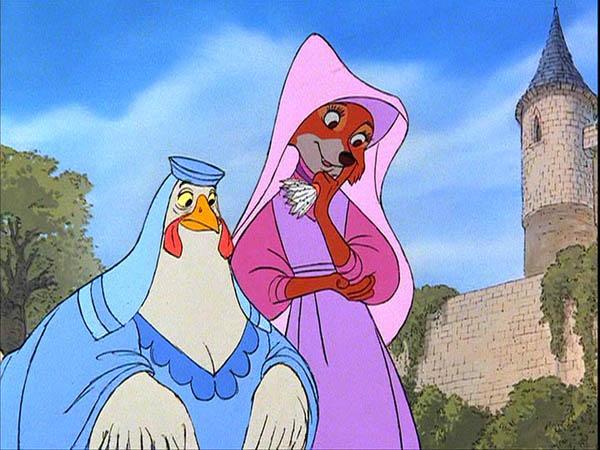 My third grade class was so obsessed with Robin Hood (we spent every recess drawing Robin and Marion, and I drew "life size" representations of them) that our teachers decided to allow us to put on Robin Hood as our class play. I played Maid Marion, and my chubby, awkward friend played her lady in waiting (the chicken).
This was the only time in my life (home or school) that I was ever cast as a princess type, and I have never thought of myself that way. In fact, part of me mourns for the princess identity I never got to have.
In searching for images I came across the Siamese cat villains from Lady and the Tramp, which I had forgotten. They sing in stereotypically Asian ungrammatical English to Asian-inspired music as they wreak havoc on the household.
These are both essentially the same movie in terms of plot and I will focus on these, as I think they are somewhat surprising when viewed through the lens of binding myths. The Brave Little Toaster involves a number of anthropomorphized (male) appliances. There is one female character in the movie briefly who is the tomboyish friend of the "master" the appliances idolize. I believe the "master's" mother is also in the movie briefly as a disembodied voice. This one seems not to perpetuate the stereotypes that we see in other Disney films. The appliances all have interesting and diverse personalities, as do the characters they encounter on their journey. Their respect for each other grows on their journey as they employ their unique traits in accomplishing their self-imposed mission. But if one can assign race and gender to appliances (they are all referred to with the pronoun "he"), then I believe these are white, male characters. There is an underrepresentation of diversity in terms of race and gender. But it is a bit of a relief to be spared a romantic pursuit based on superficial attraction followed by a wedding and a void, and the one villain in the movie, while a bit of a stereotypical geek, at least is only pursuing his own (relatively harmless) agenda of running an appliance repair shop using discarded appliances as spare parts.
Toy Story, which once again involves anthropormophized inanimate objects (this time, obviously, toys) pursuing their lost master Andy, is a more modern Disney/Pixar incarnation. In Toy Story we do have the romantic attraction between Woody and Bo Peep, but this is not central to the movie's plot. When Andy receives Buzz Lightyear for his birthday, the conflict in the movie is one that should be familiar to any older child who feels displaced by a younger sibling -- Woody's fear of losing Andy's love. Except for the suggestive and sexy Bo Peep, the only female characters are Andy's mom, his baby sister, and the evil Sid's little sister Hannah. Once again, the movie is primarily a set of white, male characters with diverse and interesting personalities.
As Disney movies go, these two seem relatively harmless, although somewhat racially bereft and gender-challenged. And Toy Story, I confess, has my favorite Disney princess, although you'll never see "her" at a character breakfast in the castle: Mrs. Nesbitt.

No comments:
Post a Comment